
Independent Scrum Caretaker, Gunther Verheyen, reveals his experience in Scrum framework implementations beyond organization’s size, branch or culture. He also emphasizes the importance of Scrum Values, humanizing the workplace and a continual active state of collaboration as the key to effectiveness.
Do you know any successful implementations of Scrum in companies that employ less than 50 people?
Over the past 14 years of Scrum, I have worked with organizations of various sizes in various industries and at different locations. I have never found a clear, linear relationship between the size of a company and the successful use of Scrum.
For some smaller organizations, organizations of the size of about 50 people you refer to, Scrum is a natural fit. Such organizations, often start-ups, tend to operate in a quite chaotic way and Scrum adds a small amount of structure and process, exactly the amount they need. In Scrum multi-disciplinary teams perform all work in Sprints, time-boxed iterations that are never more than 4 weeks, and often less. The Scrum way of organizing work helps these smaller companies to increase their focus on getting products in actually releasable versions, rather than pivoting ideas all the time. Scrum also re-enforces their approach of getting all skills to collaborate.
However, much to my surprise, plenty of such small organizations copy-paste the typical operational model of medium and large organizations, i.e. heavy governance and processes on top of people separated in functional silos. And in a situation of growth, even the small organizations that naturally operate in an agile way, tend to change towards this model. Rather than replicating their working model and thereby scale up, many break up that proven model.
The observation that most organizations sooner or later have this tendency to break their own working model has led me to create my narrative of “re-vers-ify”. With “re-vers-ify” I offer organizations a path, not a fixed destination, of re-emerging their internal structures. I invite organizations to re-imagine their Scrum and upon Scrum re-think their broader organizational model. The goal is to gradually move from a rigid organizational set-up to an adaptive, agile structure. After all, the agility an organization aspires to achieve is to a large extent dependent on their internal capability to act in an agile way. Through Scrum, organizations can un-grow toward the model that actually works and replicate it to have the same success in the large.
Which human features (or maybe weaknesses?) do you diagnose as the most difficult when working in Scrum?
In its 20+ years of existence, Scrum got mainly promoted and known as a framework for product development. When applied well, Scrum does indeed help people and organizations create excellent products (again). This is reflected in products yielding a higher return to the organization as well as improved customer satisfaction.
This rather technical promotion of the Scrum framework left the positive impact of Scrum on the workplace and the people involved in the creation of products underrated. This is why I added ‘humanizing the workplace’ to my personal ambitions as a Scrum Caretaker.
With Scrum an environment is established in which people can develop themselves, as a team as well as individually. Scrum has no detailed prescriptions for behavior and practices for every possible scenario and context. Scrum promotes self-organization. That liberates people, but also pushes them toward devising their own specific solutions, creating their own answers to the specific questions they are confronted with. Scrum reveals the need for cross-functional collaboration, but without prescribing how to achieve that. That is less obvious than it sounds, for the teams themselves as well as for supporting parts of the organization. Essentially Scrum offers the empirical process of regular inspection and adaptation to help people go through a journey of discovery, finding out what works, what doesn’t. No external forces instruct the team in their daily activities. I have found a continual collaborative stance to be key. I describe “Collaboractive People” as one key tenet of the Agile paradigm, people in a continual active state of collaboration.
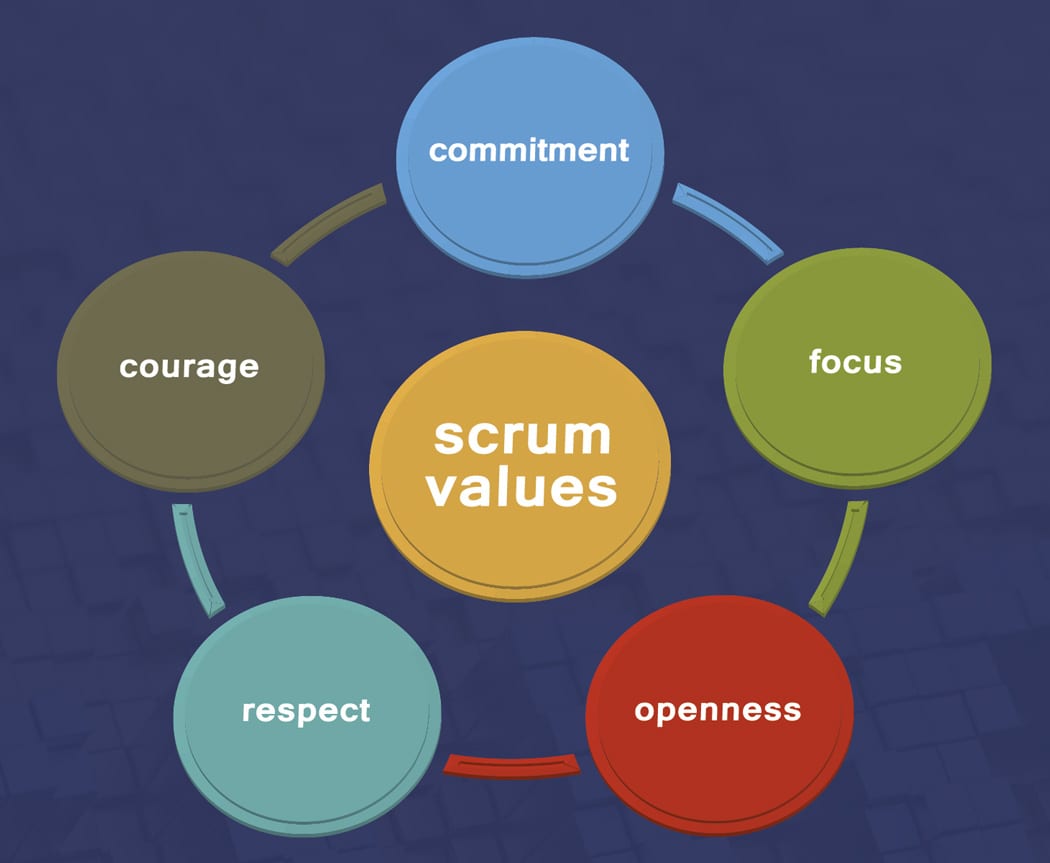
A compass to guide people through this workplace humanization process are the Scrum Values; commitment, focus, openness, respect, courage (see picture). In 2013 I described the value of the Scrum Values in my book “Scrum – A Pocket Guide”. In 2016 the Scrum Values were added to the Scrum Guide, the official body of knowledge of Scrum.
As people and teams employ the Scrum framework more effectively, the Scrum Values get enacted more. By enacting the Scrum Values, the rules of the Scrum framework can be applied more effectively.
Can you relate to Peter Drucker’s quote „Culture eats strategy for breakfast”?
I personally hardly ever use this statement by the famous management thinker. It has been used so much, and unfortunately mostly in overly simplistic and even cynical ways. Too many use the quote in order to ‘prove’ that strategies are pointless because of the unchangeable nature of ‘culture’.
Let me overcome my reluctance and go into Drucker’s quote anyhow. Culture is often said that it is what people (within some system) commonly and instinctively do or say. I say there is more to it. Culture is not just words and actions. Culture is the reflection of the common and underlying belief systems that exist within a bounded system. In the context of product and software development, I think of elements like customer-centricity, leadership style, team and other internal constructs as expressions of an organization’s culture. The products and services created by an organization, and the way that products and services are delivered to the market reflect the organizational culture upon which they were produced.
The adoption of Scrum is indeed a strategy, or a strategic choice at least. Given the beliefs and principles that Scrum thrives on, Scrum has the potential of enabling the rise of a new organizational culture. However, the beliefs upon which Scrum was created are often quite the opposite of the (industrial) beliefs that were encouraged in our industry for several decades. Like with the Scrum Values, organizational culture and Scrum as a strategic choice go hand in hand. Sure, strategic changes cannot blindly ignore culture and the limitations it creates. But I invite the readers to think of culture and strategy in terms of concurrently evolving facets of an organization. Embrace the mutually re-enforcing effect they have on each other. Don’t focus exclusively on one of them.
Do you see any differences among country cultures in Scrum being successful?
This is, beyond the over-simplified use of Drucker’s quote, the reason why I personally hardly ever mention ‘culture’ anyhow.
I have found that power structures typically reduce ‘culture’ to be a regional aspect. ‘Culture’ is explained as behavior and abilities of people in a location or region (a continent, a country, a city), sometimes an industry (financial institutions, the Internet economy, telecom, energy, car manufacturers, etc.). The term ‘culture’ is abused in order to ignore the simple fact that every human, every individual, has the intrinsic capability to self-organize, be creative and be accountable for his/her own work. This is an intrinsic human capability, regardless of region, location or industry.
My concern is to know whether an organizational context is in place that invites people to build on this potential or not. Does the environment inspire people while putting control in the boundaries, not in detailed instructions? Scrum creates such an environment, regardless of location, region or industry. I prefer to emphasize these universal advantages of Scrum without getting distracted into the obfuscating use of the term ‘culture’.
What are your impressions from Wrocław?
Visiting the 4th annual PMI congress was my first visit to Wroclaw. Given my frequent travelling I limit my visits to cities often to my professional purpose only. I haven’t been able to spend much time in Wroclaw itself, to have a really good look around.
But I have certainly seen a modernizing urban environment, with quite some technology start-ups and initiatives. I have certainly seen enough beauty inviting me to come back, and discover Wroclaw better.
And the pretty dwarf I received at the event, and who is in my home office now, surely reminds me to come back and visit all of his friends in the streets and squares of Wroclaw.
About Gunther Verheyen
Gunther Verheyen is an independent Scrum Caretaker; a connector, writer, speaker, humaniser.
Gunther discovered the magnificence of an Agile way of working through eXtreme Programming and Scrum in 2003. Since then he dedicates his professional life to Scrum. His home and office are in Antwerp, Belgium. But Gunther travels frequently to facilitate people’s understanding and use of Scrum, to help people teams, and organizations create better products and humanize their workplace.
Gunther is the author of the widely-acclaimed book “Scrum – A Pocket Guide (A Smart Travel Companion)”, also available in Dutch (“Scrum Wegwijzer”) and German (“Scrum Taschenbuch”).
Find Gunther on Twitter as @Ullizee or read more about Scrum on his website guntherverheyen.com.